Voltage dips, short interruptions and voltage variations (IEC 61000-4-11)
How immunity to supply voltage dips and interruptions is tested: causes, test generator, levels and durations, phase angles, and typical design fixes.
The mains voltage is never perfectly steady. A fault on the network, the start of a large motor or the switching of a transformer can make the voltage sag (a dip) or disappear (a short interruption) for a fraction of a second to a few seconds. Equipment should either keep working or recover in a defined way.
Causes
- faults cleared by protection devices elsewhere on the network;
- switching of large loads (motors, transformers) that draw high inrush current;
- automatic reclosing of lines and transfers between supplies.
The test method
The basic standard is IEC 61000-4-11 for equipment with a rated input current of up to 16 A per phase (European adoption: EN IEC 61000-4-11). IEC 61000-4-34 covers equipment with a rated current above 16 A per phase, and IEC 61000-4-29 covers equipment powered from DC supplies.
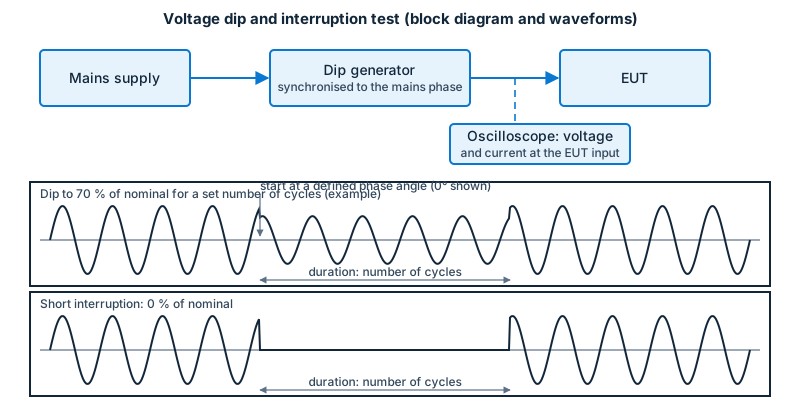
A dip generator (a programmable power source or a switching network) is placed between the mains and the EUT. It changes the supply voltage to a fraction of its nominal value and returns it, with a defined timing:
- Depth: expressed as the remaining voltage in percent of the nominal supply (for example 70 %, 40 % or 0 %, the last being a full interruption). Product standards choose the levels.
- Duration: expressed in cycles of the mains frequency, from half a cycle up to hundreds of cycles for long interruptions.
- Phase angle: a dip may start at different points of the mains waveform (for example 0° or 180°, or other angles in some cases), because the inrush and the behaviour of the power stage depend on the phase.
- Voltage variations: gradual changes (a smooth fall and rise) can also be tested, where the standard requires.
- Repetition: each condition is applied a number of times with pauses in between.
The EUT is monitored for correct operation, and the result is classified by the performance criteria of the product standard (EMC tests overview). Many product standards allow short interruptions to cause a loss of function as long as the equipment recovers by itself (criterion B or C), but are more demanding for shorter dips.
What typically happens
- Power supplies with little hold-up time drop out during a short dip because the bulk capacitor is too small.
- Microcontrollers reset or enter an undefined state when the supply falls below the brown-out threshold and recovers slowly.
- Motors, relays and contactors can drop out, and restart currents can be high.
- Data can be corrupted if a write operation is interrupted.
Design measures
- adequate hold-up capacitance or an energy reserve for the required duration;
- brown-out detection and a clean, defined power-down and power-up sequence;
- power-fail interrupts that save state before the supply is lost;
- soft start to limit inrush on recovery;
- power-factor-correction stages designed to ride through the dip.