Conducted emissions testing
How conducted emission tests work: LISN/AMN, frequency range, detectors, telecom ports, limits and typical causes of failure.
Conducted emissions are the radio-frequency noise a product sends back into the cables connected to it, most importantly the mains supply. They can disturb other equipment on the same network and, through the cable, can also radiate.
The principle
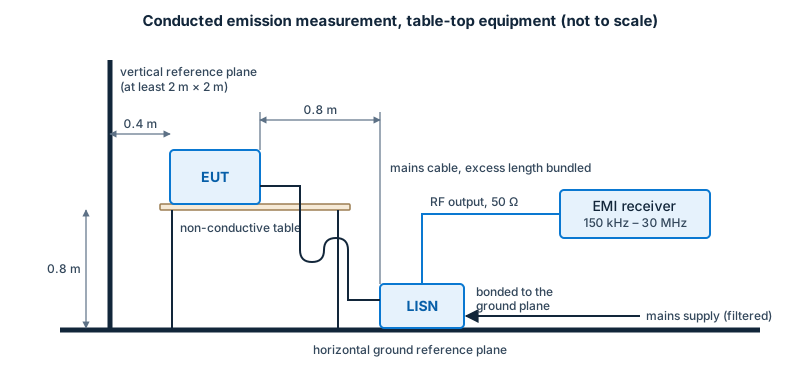
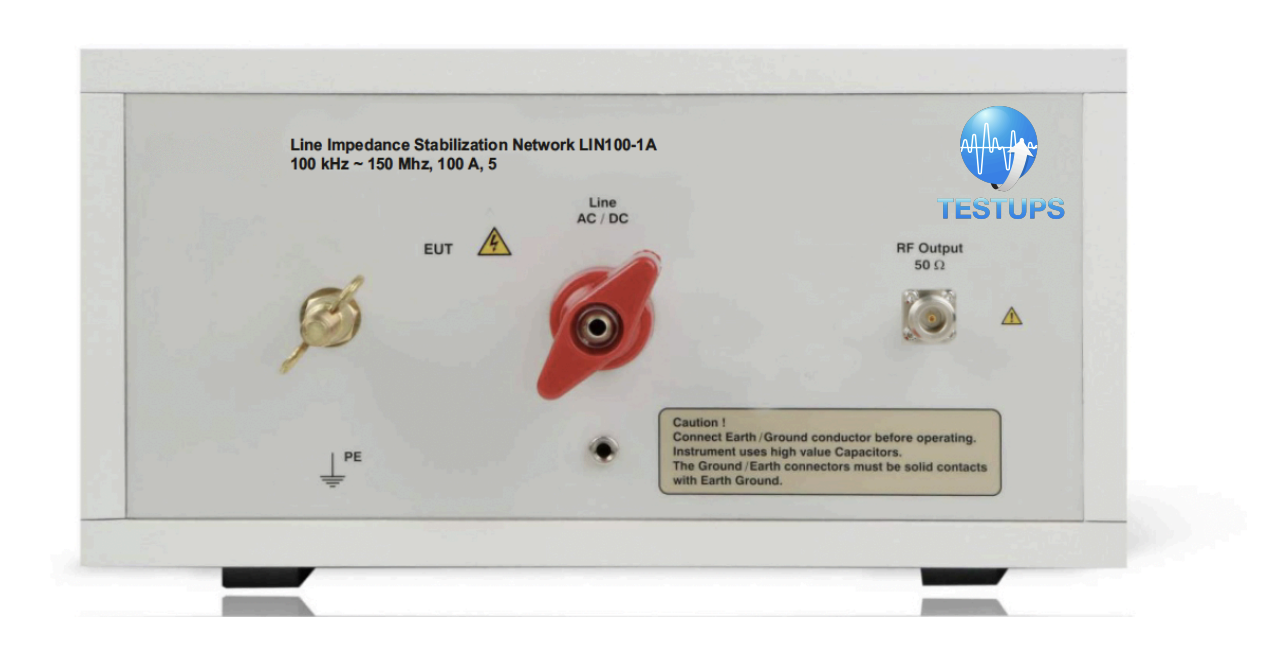
The EUT is supplied through an artificial mains network (AMN), also called a line impedance stabilisation network (LISN). The AMN does two jobs:
- It presents a defined impedance to the EUT at radio frequencies, so that the result does not depend on the unknown impedance of the building supply.
- It isolates the measurement from noise already on the mains and provides a measurement port where the noise voltage on each line can be read by an EMI receiver.
The common commercial network is the “V-network” (CISPR 16-1-2), which presents 50 Ω in parallel with a 50 µH + 5 Ω series arrangement and measures the voltage on each phase and neutral conductor against earth.
Frequency range and detectors
- Range: typically 150 kHz to 30 MHz for mains ports in the commercial standards. Some standards start lower (for example 9 kHz for certain lighting and special products) or add specific ports and ranges.
- Detectors: the quasi-peak detector and the average detector are both used, with a 9 kHz measurement bandwidth. A product normally must meet both limits. The difference between peak and average readings is also a hint about whether the noise is broadband or narrowband.
- Classes: Class A and Class B limits (Class B is stricter) as for radiated emissions.
Setup
- The EUT is placed on a non-conductive table, typically 0.8 m high, 0.4 m from a vertical conductive reference plane (for tabletop equipment), with the AMN bonded to that plane.
- The mains cable is routed to the AMN with a prescribed length; excess cable is folded.
- Each line (phase, neutral) is measured in turn.
Distances and cable handling are given in the set-up clauses of the applicable standard (for example CISPR 32, CISPR 11, CISPR 14-1, CISPR 15 or ANSI C63.4).
Other ports
Telecommunication and data ports (Ethernet, USB, antenna ports and similar) are measured with asymmetric artificial networks (AAN) or impedance stabilisation networks (ISN) that present a defined common-mode impedance (commonly 150 Ω), or with current and voltage probes where the standard allows it. The disturbance measured is mainly the common-mode component.
Some products also have discontinuous disturbances (“clicks”) from thermostats and switches; household-appliance standards (CISPR 14-1) measure those with specific counting rules and also use a disturbance-power method with an absorbing clamp in the 30–300 MHz range.
Typical causes of failure
- Switching power supplies without enough input filtering;
- poor filter layout or grounding (a filter that is bypassed by stray capacitance);
- motor drives, dimmers and LED drivers;
- insufficient common-mode choke or Y-capacitor value (limited by leakage-current safety rules).
A power-line filter combines differential-mode (X capacitors, series inductance) and common-mode (common-mode choke, Y capacitors) sections. Its effect depends on the source and load impedances, which is why filters are specified in a defined test system and may behave differently in a product. See Design for EMC.
Related harmonic and flicker tests
Low-frequency conducted effects (harmonic currents and voltage fluctuations/flicker) are separate requirements under IEC 61000-3-2 and 61000-3-3 and are not part of the radio-frequency conducted-emission test (batch 2 will cover them).