
EMC tests: an overview
The main families of EMC tests (emissions and immunity), what each checks, how test plans, performance criteria and laboratories fit together.
EMC tests answer two questions: does the product disturb others (emissions), and does it keep working when disturbed (immunity)? Each question is split into tests for the different ways energy travels and the different kinds of disturbance.
The test families
| Question | Test | What it checks | Page |
|---|---|---|---|
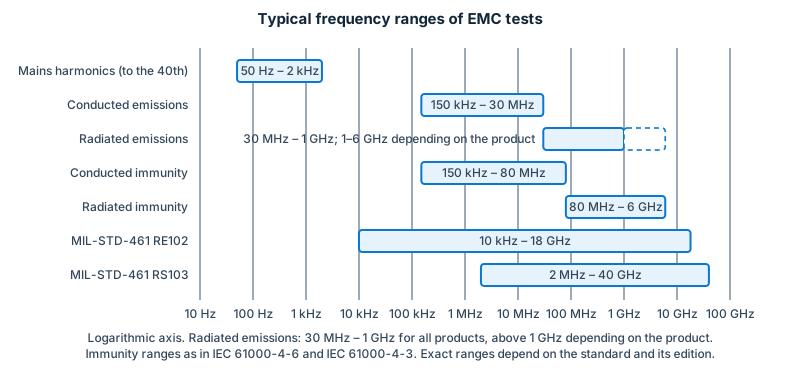
| Emissions | Radiated emissions | Fields radiated by the product, 30 MHz and above | Radiated emissions |
| Emissions | Conducted emissions | RF noise returned to the mains and other cables, from 150 kHz | Conducted emissions |
| Emissions | Harmonics and flicker | Low-frequency effects of the load on the supply | Harmonics and flicker |
| Immunity | Radiated immunity | Operation in an RF field | Radiated immunity |
| Immunity | Conducted immunity | Operation with RF induced on cables | Conducted immunity |
| Immunity | ESD | Operation after electrostatic discharge | ESD |
| Immunity | EFT/burst | Operation with fast transient bursts | EFT/burst |
| Immunity | Surge | Operation after lightning and switching surges | Surge |
| Immunity | Voltage dips and interruptions | Operation when the supply sags or drops out | Voltage dips |
| Immunity | Power-frequency magnetic field | Operation near strong 50/60 Hz fields | Magnetic field immunity |
What decides the list of tests
- The product or generic standard that applies (see the standards map) selects the tests, the ports to test and the severity levels.
- The market (see regulations by region) decides which of them are legally needed.
- The customer or sector (automotive, medical, railway, aerospace) can add requirements.
The test plan
A good test plan, agreed before testing, states:
- the configuration of the equipment under test (EUT): hardware and software versions, cables, loads, peripherals;
- the operating modes that represent typical use and the worst case for emissions and for immunity;
- the ports to be tested (enclosure, AC and DC power, signal and telecom ports);
- the monitoring method and the performance criteria (see below);
- the standards, editions and severity levels;
- the reporting format.
Performance criteria
Immunity standards do not decide what “working” means; the product standard or the test plan does. The common three-class scheme is:
- Criterion A: normal performance during and after the test, within the specified limits;
- Criterion B: temporary degradation or loss of function during the test is accepted, with self-recovery afterwards;
- Criterion C: temporary loss of function is accepted if recovery needs operator intervention or a reset.
Laboratories
Tests are carried out in the manufacturer’s own laboratory or by an independent laboratory. Many laboratories are accredited to ISO/IEC 17025, which means their competence, equipment calibration and uncertainty evaluation are independently assessed. Whether accreditation is required depends on the regulation. See Test facilities and site validation and Measurement uncertainty.
Before the formal test
Problems are cheapest to fix early. Pre-compliance testing and design for EMC help a product reach the formal test with a good chance of passing.