Power-frequency magnetic field immunity (IEC 61000-4-8)
How immunity to 50/60 Hz magnetic fields is tested: sources, the induction coil method, test levels, and which products are sensitive.
Magnetic fields at the mains frequency (50 or 60 Hz) and its harmonics are produced by power cables, transformers, busbars, motors and any conductor that carries current. Most electronic equipment is not affected, but magnetically sensitive devices can be disturbed.
Which products are sensitive
- devices with cathode-ray tube displays (the image jitters);
- Hall-effect sensors, magnetometers and compasses;
- inductive sensors and loop antennas;
- equipment with magnetic components that saturate (some transformers, relays);
- medical and measurement equipment with sensitive analogue front ends.
Many product standards apply the test only to such products.
The method (IEC 61000-4-8)
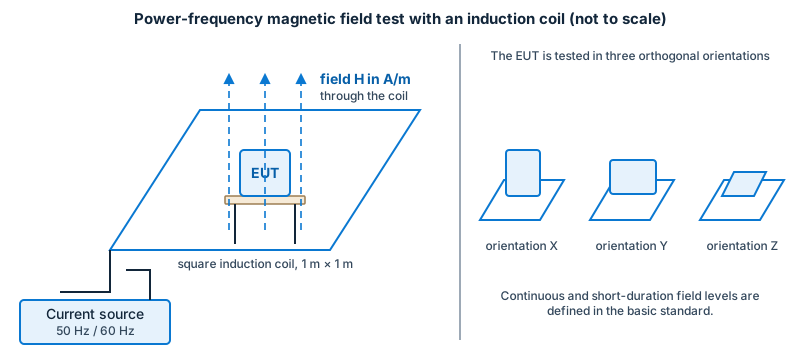
The EUT is placed in the field of an induction coil: a large square coil that produces a nearly uniform field over the volume of the EUT, driven by a current source at the mains frequency. A standard coil is 1 m on a side, with larger coils or a two-coil arrangement (a “Helmholtz” arrangement) for larger EUTs.
- Field strength is stated in amperes per metre (A/m). Commonly used continuous levels are 1, 3, 10, 30 and 100 A/m; higher short-duration levels (a few seconds) represent faults. The product standard chooses the level.
- The EUT is exposed in three orthogonal orientations, so that the field passes through it in each axis.
- It is operated normally and monitored for degradation (for example a display jitter, a change of reading).
Related methods
- IEC 61000-4-9 applies a pulse magnetic field (representing lightning or fault currents in nearby conductors).
- IEC 61000-4-10 applies a damped oscillatory magnetic field (representing switching in high-voltage substations).
Mitigation
- Distance: the field falls off quickly with distance from the source.
- Magnetic shielding with high-permeability material (for example mu-metal) around the sensitive part; aluminium and copper do not shield low-frequency magnetic fields well.
- Design: twisted pairs and small loop areas reduce the pick-up; rotate or relocate the sensor; use compensation.