
The EMC standards map: CISPR, IEC 61000 and product standards
A guide to how EMC standards are organised: CISPR emission standards, the IEC 61000 series, generic and product-family standards, and the automotive, MIL-STD-461, aerospace, railway and medical families.
EMC standards look confusing because three layers overlap. This page shows how they fit together. Standards are named for identification only; the texts are copyrighted and are not reproduced here. Always use the current edition.
Layer 1: basic standards (how to measure or test)
Basic standards define a method or a phenomenon but do not say which products must pass or at what level. Product or generic standards choose the method and the level.
- CISPR 16 series — specification of radio-disturbance measuring apparatus (receivers, detectors, artificial networks, antennas, test sites) and measurement methods and uncertainty. Parts commonly cited: 16-1-1 (measuring apparatus), 16-1-2 (conducted-disturbance coupling devices), 16-1-4 (antennas and test sites), 16-2-1 (conducted measurements), 16-2-3 (radiated measurements), 16-4-2 (uncertainty).
- IEC 61000-4-x — immunity test and measurement techniques (the “basic immunity” series). Frequently used parts:
| Part | Subject |
|---|---|
| 61000-4-2 | Electrostatic discharge (ESD) immunity |
| 61000-4-3 | Radiated radio-frequency electromagnetic field immunity |
| 61000-4-4 | Electrical fast transient/burst immunity |
| 61000-4-5 | Surge immunity |
| 61000-4-6 | Immunity to conducted disturbances induced by radio-frequency fields |
| 61000-4-8 | Power-frequency magnetic field immunity |
| 61000-4-11 | Voltage dips, short interruptions and voltage variations (equipment up to 16 A per phase); 61000-4-34 covers equipment above 16 A |
| 61000-4-20 | Emission and immunity testing in TEM and GTEM cells |
| 61000-4-21 | Reverberation-chamber methods |
- IEC 61000-3-x — limits for emissions into the public supply: harmonic currents (61000-3-2, up to 16 A per phase), voltage changes and flicker (61000-3-3), and the equivalents for higher currents (61000-3-11, 61000-3-12).
- IEC 61000-1 and -2 (general topics; the electromagnetic environment and compatibility levels) and 61000-5 (installation and mitigation guidance).
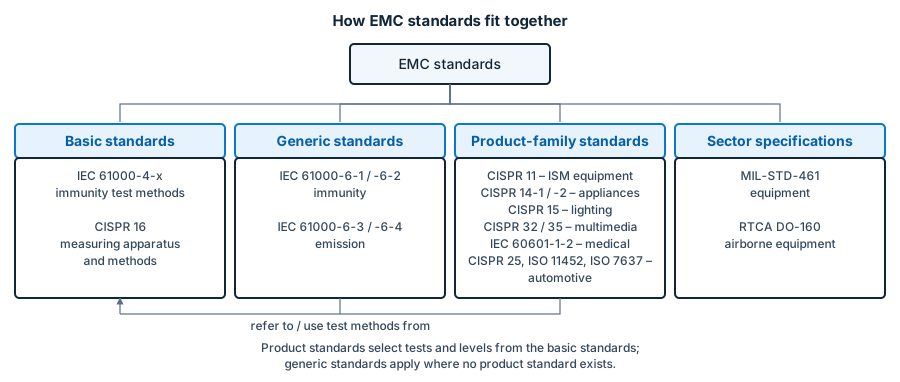
Layer 2: generic standards (when there is no product standard)
- IEC 61000-6-1 (immunity, residential/commercial/light-industrial) and 61000-6-2 (immunity, industrial environments).
- IEC 61000-6-3 (emissions, residential/commercial/light-industrial) and 61000-6-4 (emissions, industrial environments).
They are used when no specific product-family standard applies. The environment (“residential” versus “industrial”) sets the limits.
Layer 3: product-family standards
| Product family | Emissions | Immunity |
|---|---|---|
| Multimedia (IT, audio, video, broadcast receivers) | CISPR 32 / EN 55032 | CISPR 35 / EN 55035 |
| Industrial, scientific and medical (ISM) RF equipment | CISPR 11 / EN 55011 | IEC 61000-6-2 or product standard |
| Household appliances, tools and similar | CISPR 14-1 / EN 55014-1 | CISPR 14-2 / EN 55014-2 |
| Lighting | CISPR 15 / EN 55015 | IEC 61547 / EN 61547 |
| Laboratory, measurement and control equipment | IEC 61326-1 (emissions and immunity in one standard) | |
| Adjustable-speed electric drives | IEC 61800-3 (emissions and immunity) | |
| Alarm systems | EN 50130-4 | |
| Radio equipment (EU) | ETSI EN 301 489 series (EMC) alongside ETSI radio standards |
Some of these have replaced older documents: CISPR 32 replaced CISPR 22 and CISPR 35 replaced CISPR 24 for multimedia equipment. Check which edition applies in your market: the EU list of harmonised standards, the GOV.UK designated-standards lists and the FCC rules each give the references the regulator accepts.
Sector standards
Automotive
CISPR 25 (protection of on-board receivers, component and vehicle level), ISO 11452 series (component immunity), ISO 11451 series (vehicle immunity), ISO 7637 series (electrical transients on supply and other lines), ISO 10605 (ESD), ISO 16750-2 (electrical loads), UN Regulation No. 10 (the legal EMC requirement for type approval), CISPR 12 and CISPR 36 (protection of off-board receivers). See Automotive EMC.
MIL-STD and aerospace
- MIL-STD-461 (requirements for control of electromagnetic interference characteristics of subsystems and equipment; test codes such as CE102, CS114, RE102, RS103) and MIL-STD-464 (system-level electromagnetic environmental effects).
- RTCA DO-160 / EUROCAE ED-14 (environmental conditions and test procedures for airborne equipment, with sections on radio-frequency emission and susceptibility, lightning and others).
- Space programmes typically use their own EMC standards (for example the ECSS series in Europe).
Medical
IEC 60601-1-2 (basic safety and essential performance of medical electrical equipment, EMC requirements and tests), with IEC 61326-2-6 for in-vitro diagnostic equipment. Immunity levels depend on the use environment (professional healthcare facility, home healthcare).
Railway
EN 50121 series (railway applications — EMC), with parts for the whole railway system, rolling stock, signalling and telecommunications and fixed power installations.
Marine
IEC 60945 (maritime navigation and radiocommunication equipment — general requirements, including EMC).
Reading a standard citation
- CISPR 32 is the international document. EN 55032 is the European adoption (same technical content, sometimes with European differences). BS EN 55032 is the British adoption; NF EN 55032 the French. National versions carry the international number inside them.
- A year or “A1/A2” suffix identifies the edition or amendment. “EN IEC” prefixes mark European adoptions of IEC documents published since about 2018.
- Harmonised means cited in the Official Journal of the EU (or a UK designated list) so that conformity gives a presumption of conformity with the law; it is a legal status, not a technical one.
Where to get the official versions
IEC and CISPR publications are sold through the IEC webstore and national standards bodies. European adoptions are available through CEN/CENELEC members. Many regulators publish the list of standards they recognise: the European Commission (EU), GOV.UK (UK), the FCC rules (USA).