
Pre-compliance testing
How to find EMC problems early: near-field probes, current probes, artificial networks, spectrum analysers, and how to use margins and compare results with formal tests.
Pre-compliance testing is informal or reduced testing during development. It does not give a compliance statement, but it finds the big problems cheaply and lets the design be fixed before the formal test.
Why it pays
A failed formal test costs the test fee, the delay and, often, a hardware change. A pre-compliance check on the prototype takes hours and can be repeated after each change.
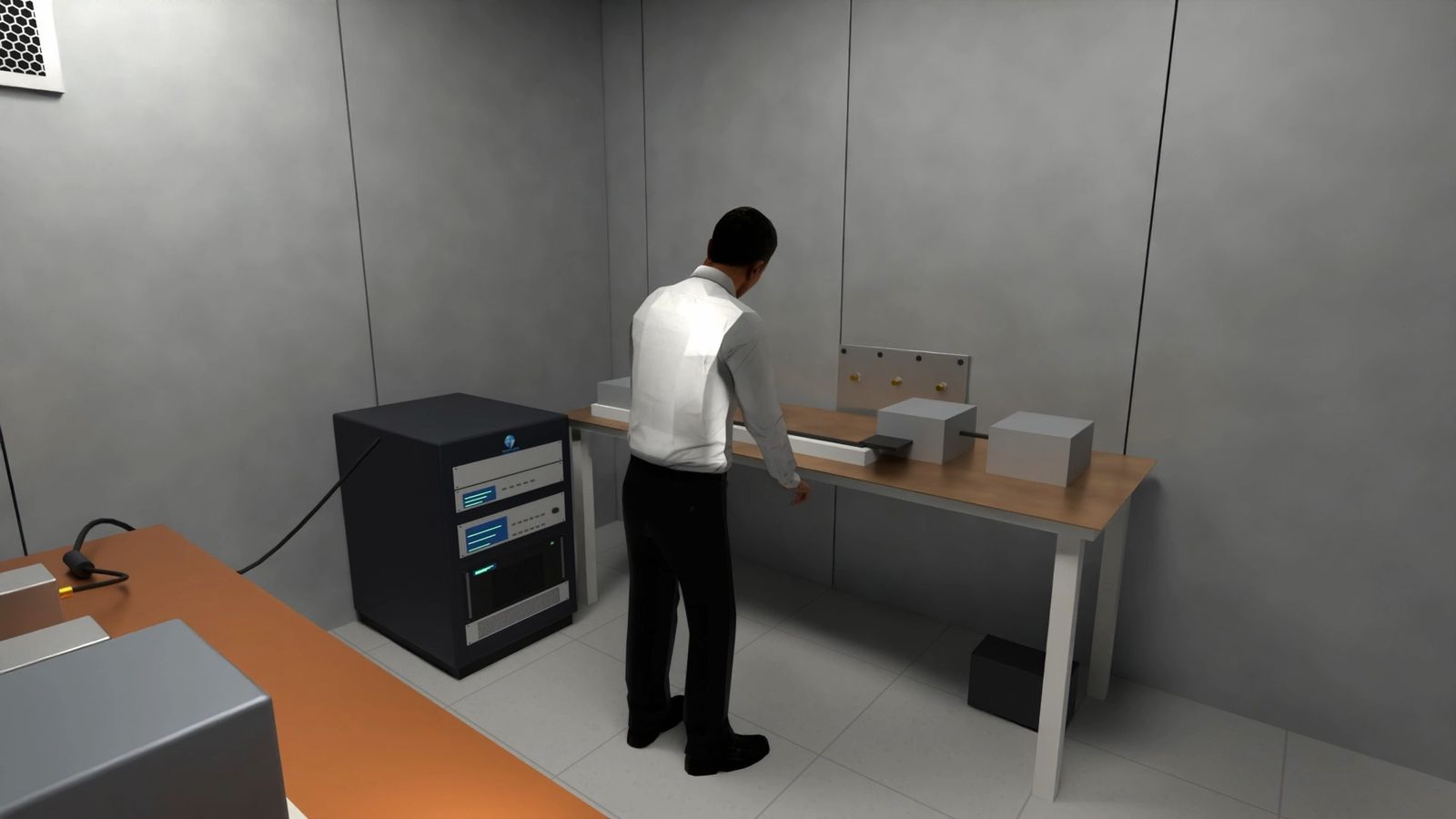
Emissions
Near-field probes (small loops and stubs) with a spectrum analyser find which parts of a board or cable emit most: they show where the energy is, not the absolute field strength at a distance.
Current probes (clamps) on cables measure the common-mode current, which is the best early indicator of radiated-emission problems, because cables are the main antennas. Changes that reduce the cable current usually reduce the radiated field.
Conducted emissions can be checked well with an artificial mains network (LISN), a spectrum analyser (or receiver) and a transient limiter. This is the part of pre-compliance that best correlates with the formal test.
Radiated emissions can be estimated with an antenna at a short distance (in a quiet place), a GTEM or small chamber, or by relative comparison: measure the product before and after a change, and measure a known compliant product as a reference. Absolute accuracy is limited by the site (reflections and ambient signals) and by the antenna’s distance.
Immunity
- ESD: a simple ESD generator applied to the points a user could touch finds weak points early.
- EFT/burst and surge: a burst or surge generator on the power and signal ports, at reduced levels first.
- Radiated and conducted immunity: a transmitter or a signal generator and amplifier with a field-generating antenna in a controlled area can give a first indication; calibrated fields need a validated setup.
- Supply dips: a programmable source or switching network.
Margins
Because the formal test is done at another site, with different cables and a measurement uncertainty, engineers commonly aim for a margin to the limit in pre-compliance (several dB). The margin that is sensible depends on how well the pre-compliance setup correlates with the formal site; a laboratory can help to calibrate this by measuring a few reference products on both.
Practical tips
- Fix the configuration (cables, loads, firmware) and keep it for the formal test.
- Start with cables: measure common-mode current on every cable, then try changes (cable routing, ferrite, shield termination).
- Measure before and after each change.
- Document what you changed and the result.
- Keep ambient signals in mind and use a shielded room or a quiet location for low-level measurements.
Limits
Pre-compliance results cannot be used to claim compliance. For anything that will be declared to a regulator, use a formal test at a calibrated and validated site (see Test facilities and site validation).