
EMC regulations by region: an overview
How EMC is regulated in the EU, UK, USA, Canada, China, Japan, South Korea and Australia/New Zealand, with a comparison table and links to the official sources and the detailed region pages.
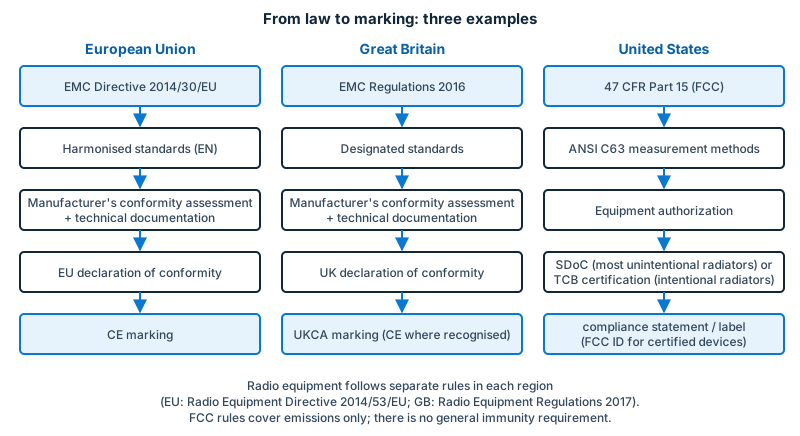
EMC is regulated almost everywhere, but the legal mechanism differs. Some regions rely on self-declaration against recognised standards (EU, UK, and the USA and Canada for most products), some require certification or registration for listed products (China, Korea), and Japan uses a voluntary industry council for information technology equipment. This page is an orientation, not legal advice: each region page links to the official legal texts, and the authority named there is the place to check the current requirements.
Comparison
| Region | Main instrument | Marking | Route (typical) | Immunity required? |
|---|---|---|---|---|
| European Union | EMC Directive 2014/30/EU; Radio Equipment Directive 2014/53/EU | CE | Manufacturer’s assessment against harmonised standards, EU declaration of conformity | Yes (essential requirement) |
| United Kingdom | EMC Regulations 2016; Radio Equipment Regulations 2017 | UKCA (see GOV.UK for CE acceptance) | Manufacturer’s assessment against designated standards, UK declaration of conformity | Yes |
| United States | FCC rules, 47 CFR Part 15 and Part 18 | FCC statement / label | Supplier’s declaration or certification depending on device type | No general requirement |
| Canada | ISED ICES standards | e.g. “CAN ICES-003(B) / NMB-003(B)” | Testing, record-keeping and label | No general requirement |
| China | China Compulsory Certification for listed products; radio type approval | CCC | Certification by designated bodies | For listed products, via the applicable standards |
| Japan | VCCI voluntary rules for IT equipment; Radio Act for radio equipment | VCCI statement; Giteki mark for radio | Voluntary declaration; registered certification body for radio | For radio equipment, via the technical regulations |
| South Korea | Radio Waves Act; KN standards | KC | Certification, registration or declaration depending on product | Yes, through KN 35 for multimedia equipment |
| Australia and New Zealand | ACMA EMC arrangements | RCM | Supplier registration, labelling and records | Not for most products |
Common threads
- Emissions are regulated almost everywhere. The limits come from CISPR documents, often with national adoptions (EN, BS EN, GB/T, KN, AS/NZS).
- Immunity is regulated mainly in the EU/UK and in Korea; in the USA and Canada it is mostly a market or customer requirement (except for sectors such as medical devices).
- Radio transmitters are handled separately from unintentional radiators: the EU RED, the FCC rules for intentional radiators, Canada’s RSS standards, Japan’s Radio Act, China’s radio type approval and Korea’s radio rules.
- Vehicles have their own scheme almost everywhere: UN Regulation No. 10 for type approval in the countries applying the UN 1958 Agreement (see Automotive EMC).
- Rules change. The pages name the authority responsible for each region; use that source for the current position.
Other markets
Many other markets have their own schemes, for example India (BIS), Taiwan (BSMI), Brazil (Anatel), the Eurasian Economic Union and Saudi Arabia (SASO). They are not covered here; check the national authority.
Sources
- EU EMC Directive 2014/30/EU (EUR-Lex)
- UK Electromagnetic Compatibility Regulations 2016 (legislation.gov.uk)
- US FCC rules, 47 CFR Part 15 (eCFR)
- ISED Canada, Interference-Causing Equipment Standards
- China: CNCA
- Japan: VCCI
- Korea: National Radio Research Agency (RRA)
- Australia: ACMA requirements for the RCM (EESS)