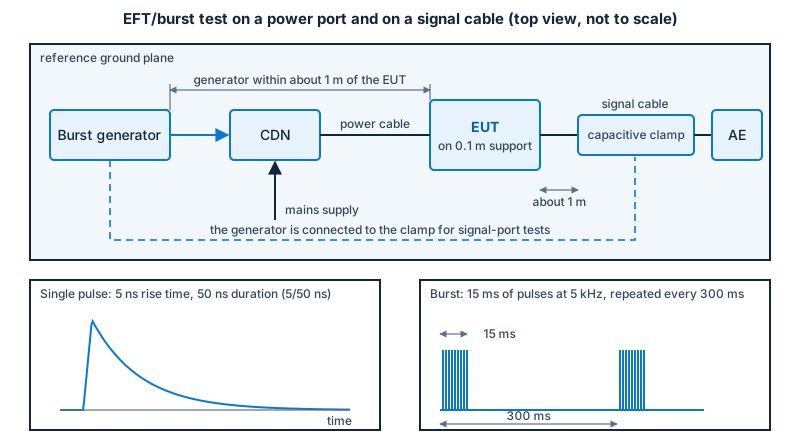
Electrical fast transient (EFT/burst) immunity testing (IEC 61000-4-4)
What fast transient bursts are, how the EFT/burst test is applied to power and signal lines, waveform, repetition rate, test levels and common failure modes.
When a relay, contactor or switch interrupts an inductive load, the energy stored in the inductance produces a train of fast, repeated voltage pulses on the supply wiring: not one big surge, but many small, very fast ones. EFT/burst testing applies such pulse trains to a product to see whether it keeps working.
The signal
The basic standard is IEC 61000-4-4 (European adoption: EN 61000-4-4). The generator produces pulses with a 5 ns rise time and 50 ns duration at half amplitude (written 5/50 ns), delivered in bursts:
- inside a burst the pulses repeat at a fixed rate; the common repetition frequencies are 5 kHz, with 100 kHz allowed or required for some product standards because it represents the real transient better;
- each burst lasts about 15 ms (at 5 kHz) and bursts repeat every 300 ms;
- the test lasts a stated time (typically at least one minute per polarity and port).
Test voltage levels are in steps (for example 0.5, 1, 2 and 4 kV on power ports; half that on signal and control ports) and the product standard chooses the severity. The waveform is defined across a 50 Ω load, and also across 1 kΩ, to ensure the generator behaves correctly.
How it is coupled
- Power ports: through a coupling/decoupling network (CDN) that puts the pulses on the supply conductors (line, neutral, earth, or combinations) while preventing them from travelling back to the mains.
- Signal and control lines (I/O and communication cables): through a capacitive coupling clamp, a metal plate-and-foam clamp that couples the bursts to the cable without a direct connection.
- Earth (PE) and screens: coupled where the product standard requires it.
The EUT is placed on a ground reference plane with an insulating support; cable lengths and positions are fixed because the result depends strongly on layout.
Why the test matters
Fast bursts have broad-band content to several hundred MHz and couple capacitively into cables, even those that are not directly connected to the source. The most common failures are resets, lock-ups and corrupted data in microcontroller-based equipment. Because the pulses are repeated, they are also a good test of firmware robustness.
Performance criteria
The same classification as other immunity tests is used (A, B and C, as in radiated immunity). For control equipment criteria B (temporary degradation, self-recovery) is common for EFT.
Typical remedies
- Input filtering with common-mode chokes and capacitors at the power and signal entry;
- transient suppression (varistors, TVS diodes, gas-discharge tubes);
- cable shields terminated 360° at the enclosure instead of with pigtails;
- separation of noisy and sensitive tracks and a solid ground plane;
- watchdog, retry and error-checking functions in firmware.